
The Macintosh Platform has had a big effect on my career. On the 30th anniversary of the launch of the Mac, I figured I would write-up a few memories and talk about my time managing a large number of Macs back in the early days. Here are some observations of a guy who has stayed at one company for the last 22 years working with Macs.
First, a few early Mac memories. I can remember seeing the 1984 commercial during the Superbowl. As a teenager into sci-fi this commercial definitely made an impact. At the time I was a Commodore 64 guy, the Apple products seemed to so expensive and more aimed at younger kids classrooms. The C64 could use a TV as a monitor, had both a floppy drive and a game cartridge port, and cost around 200 bucks. The Apple II’s of the era were way out the price range that I could talk my parents into spending. As cool as the commercial was, I thought “too bad it is from Apple.” It is funny how loyal I felt to the C64, despite more than once the C64 losing hours of typing when it crashed. I still save right before printing based on a habit I learned on the C64.
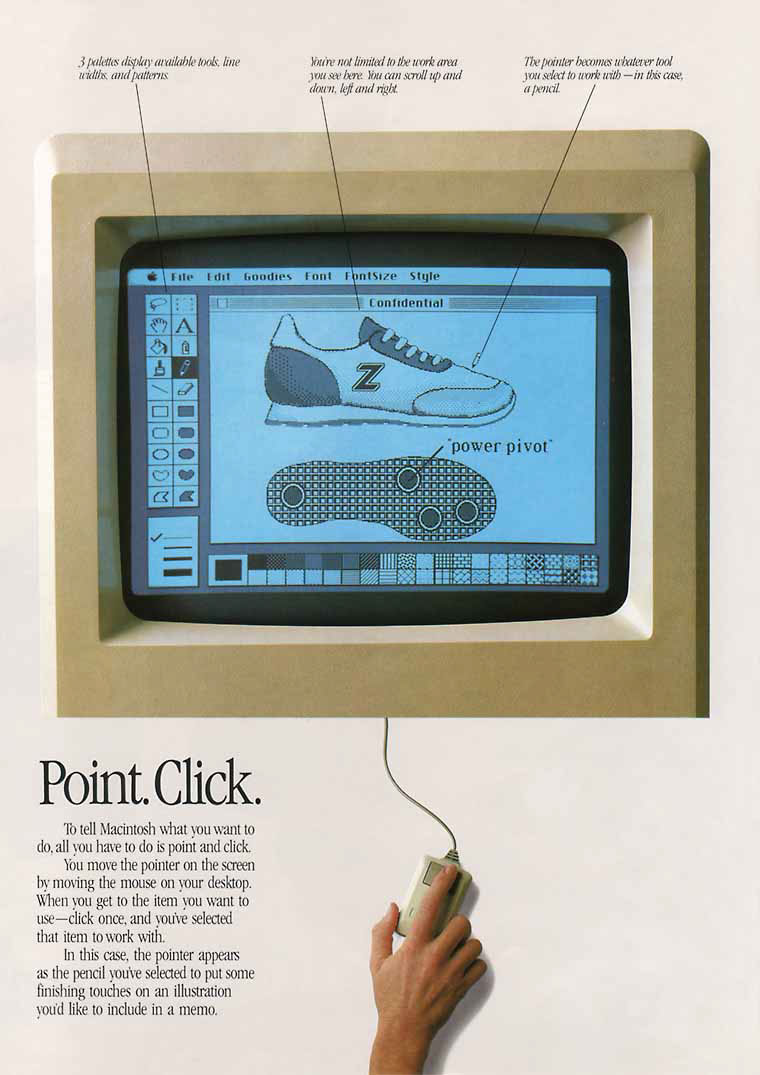
In the mid 80’s my family subscribed to TIME magazine. At some point soon after the Mac shipped, the insert that initially ran in Newsweek must have ran in TIME because I remember pouring over the mini brochure. In particular, there was a picture of a sneaker that I can remember really studying. It was so sharp, so unlike anything that ever appeared on the screen of the C64. To get the C64 to do anything visual required coding. I remember typing in around 100 lines of code from a magazine to make a “sprite” (a white box) move across the screen of the C64.
My next experience with the Mac was in the late 80’s in college. There was a rather large Mac lab of around maybe 50 Mac Plus and Mac SE computers using a bring your own floppy model. To use the you gave the lab guys a blank floppy, and they would set you up with a system disk. Every time you came into the lab, you would push your the disk into a Mac with a flashing ? disk icon. I guess in a way this was the first portable home directory system. The Mac SE, with it’s dual floppy drives, were always harder to get. As I got to know the Mac lab better, I learned how to navigate though the shared file system over localtalk and StuffIt. Every operation took minutes and sometimes many disk swaps, but I was hooked.
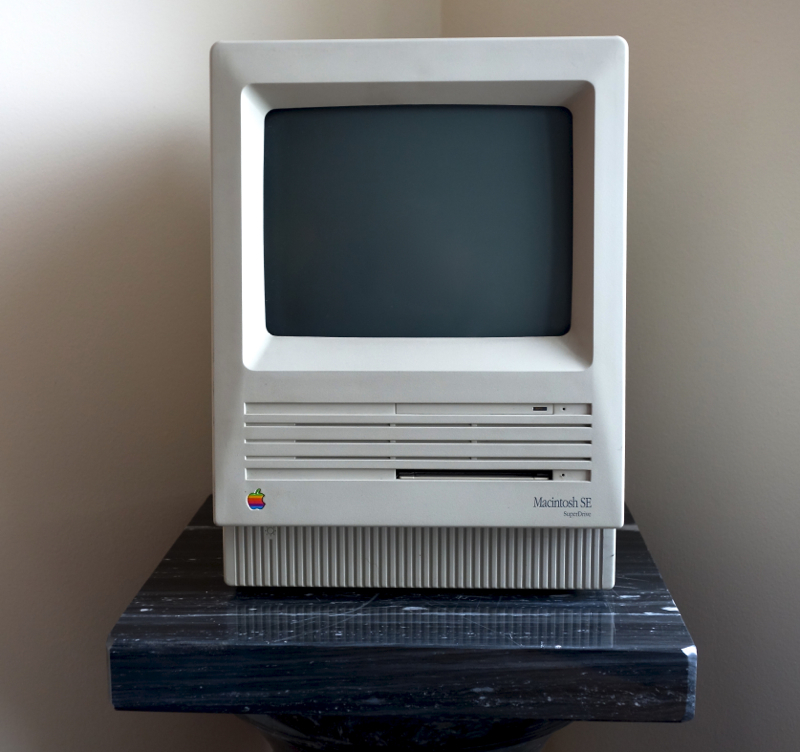
The SE had the option of dual floppy drives or an internal hard drive. The SE also introduced the ADB port for keyboard and mice. The SE’s elder brother the SE 30, a great machine in its own right, gets much more homage than the SE these days, but for me the SE belongs in the hall of fame. When I first started using the SE, it was before I was aware of mhz as a measure of computer speed. When I graduated from college, I scraped together the money to buy my first Mac, which was an SE with a 40 meg internal hard drive. It is still here in my living room, on a pedestal.
After a few years of hanging out in the Mac lab using floppy based macs to write reports and play the occasional game, I became aware of a room on the 4th floor of the photo building that was full of Macs doing things with photography. Soon, I was hanging out in this room, using the Mac II and Mac IIx machines hooked up to color Apple RGB 13 inch monitors. I can remember seeing the color stripes of the Apple logo on screen for the first time on those screens. One of the machines had a 20 inch monitor, but it was hard to get time there. A new model arrived that the professor who ran the lab was very excited about. In honor of the new speed this machine promised, the Hard Drive was named 25mhz. The Mac IIci had arrived.
The Mac Iici was the workhorse machine in the early 90’s. Smaller than the rest of the II line, the Iici was the computer on my desk the day I started at the company.
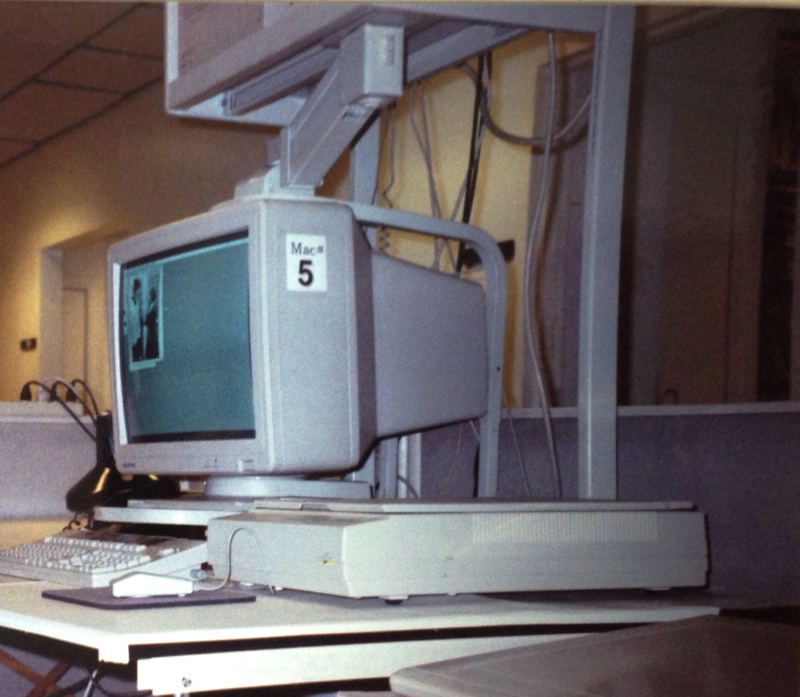
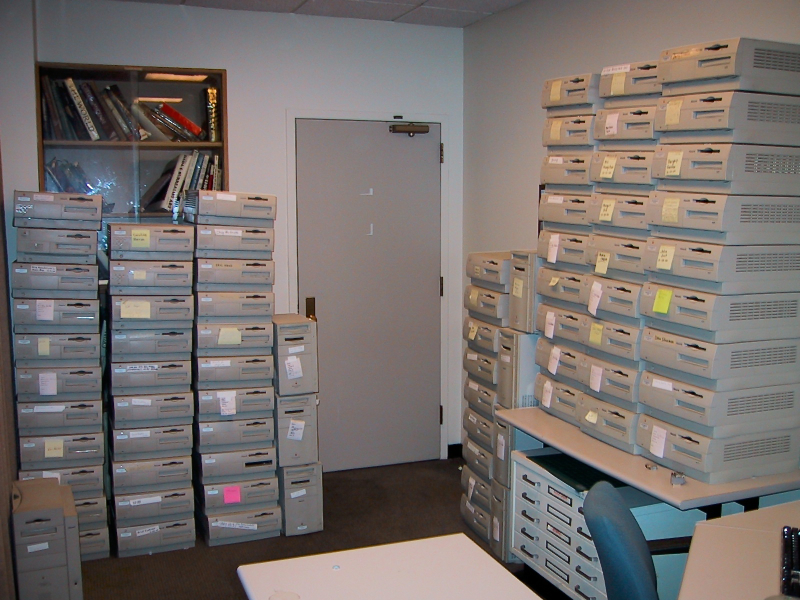
Over the course of the IIci lifecycle some were upgraded the to a 68040 processor via a Daystar card in the cache slot. More than once, I used one as step stool to reach a high shelf. It was a great case, easy to service and stack. The Quantum 40 and 80 meg hard drives they ran were a bit finicky.
Apple released machines based on the 68040 processor, the Quadra line (quad – 040 processor, get it?). The machine of this era that had the biggest impact on me was the Quadra 800. Not as big as the massive Quadra 950, the 800 was a decent machine that has a stamped metal case. Access to the internals came by loosening 4 screws that you could turn with your fingers most of the time. The case design worked well enough that it started the Apple trend of reusing an old design over and over on a new models with better processora. The case saw continued life through the PowerPC based 8100, 8500, and 8600 series, and even got extruded to longer design for the 9000 series of machines. I can still remember the series movements required to pull the case off of one of these machines, and how to avoid the few sharp edges that could scrape a knuckle. I had the first Quadra 800 the company bought on my desk (you know, for testing), and it was the first model that I saw go through the entire life cycle of purchase, install, food chain to less demanding users, removal, and eventual disposal with an e-waste recycler.
The PowerPC era brought a new wave of machines to the company in the form of the 7500 and later the 7600 series of computers. These cases felt like the return of the ci in some ways, and had a neat fold out frame that allowed access to the motherboard. For less horse power driven job functions we bought these instead of 8000 series. The cases also stacked well.
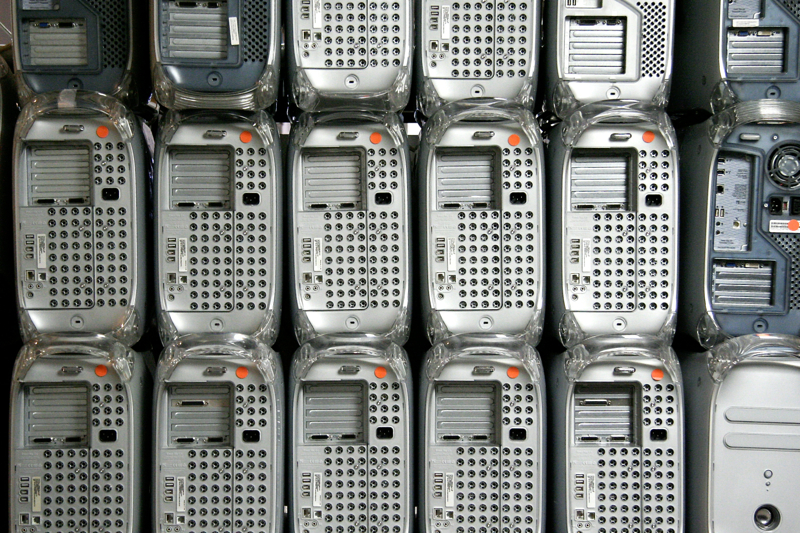
Steve Jobs returned to Apple and brought a new sense of design to the computers. This, of course, is best embodied in the iMac. In our production environment, the new design first showed up in the Blue and White G3 tower. This had translucent plastic like the iMac, and had handles on the four corners. It also had an innovative door that swung open to revel access to the motherboard, which was on the inside of the door. The Blue and White was never a great machine, but the it started the long process of converting from SCSI and ADB ports to USB and Firewire for keyboards, mice and external hard drives. Like the other port conversions over the years, this transition happened slowly as older devices where slowly phased out. The worst of these port changes was with the video connector, with Apple changing from DA-15 (generally known as a DB-15 to those who referred to it all) to VGA to ADC to DVI to Mini Display Port to Thunderbolt. And don’t forget the mini VGA, miniDVI and the Apple MultiMedia Display (used on the 6100 and some Centris computers) that could have you scrounging around for the right adapter. Hopefully the connector used in Thunderbolt will be here for a while.
The case for the Blue and White lasted thru the next three models of tower macs, the Graphite G4, the Quicksilver G4 and the Mirror Drive Door (known as MDD’s.) Each model was heavier than the one before, and each one had more vents on the back side. If you were careful, they could be stacked up together, but we tried to do this only when they where on the way out. These machines served the needs of the more power intensive job functions, and were the end of the OS 9 era.
For users needing less power, the later generation CRT based iMac’s became a useable option. The original iMac did not have a Firewire port, but later iMac models with Firewire were decent machines in our environment. While we bought plenty of G5 and Mac Pro “cheese grater” towers, the iMac started replacing them over the last five to seven years, and now the tower machines have almost completely been replaced by iMacs. We will likely buy only a handful of new Mac Pro cylinders. And, the cycle is starting again, in places where the iMac was ideal, we are now moving toward a laptop with an external display.
Apple has taken the Mac thru several major transitions, the 68k to Power PC processor, the OS 9 to OS X, and the Power PC to Intel processor. It is a testament to Apple that I don’t recall much hardship making these moves. Of course, managing an environment of hundreds of computers, you need to be conservative and move slowly. For example, with OS X, we waited to upgrade until we had no need for the “classic” environment. Or with the Intel transition, we kept a some PowerPC application dependent users on OS X 10.6 until recently. While Apple likes to live in the now and never look back, large sites have always moved more slowly and take years to make major moves. Apple policy of new machines only running the latest OS has caused us to do some shuffling around of machines on occasion, but the being forced to use the newest OS puts pressure on staying current and makes it a worthwhile trade off in my opinion. On the Windows side, I sometimes wonder had XP supported more than 4 gigs of ram if the company would have ever made the leap to Windows 7.
When you look back the the Apple’s history of Macintoshes, like this list, or this chart, you can see how Apple took chances on edgy designs with machines like the original Mac Portable, the Cube, the 20th Anniversary Mac, and even the first Mac Book Air. At my company, sometimes we would purchase a couple of these edgy machines to try out. For example, we bought a couple of Cubes, but they were too expensive and fussy. Every time you needed to check a cable connection, the machine had to be turned over to reach the ports on the bottom, we were concerned users would stack stuff on top of them, etc. One the Cube’s did work well in the design director’s office. The much more mundane machines were what Apple sold the most of, and what kept the Mac alive through its darkest days. Some of those edgy machines, like the original iMac with only USB ports, Apple refined until they became great production level machines. Even the Mac Air, which on first generation seemed best for, maybe, the executive suite, now has a place in the fleet of Macs in use at my company. Apple has always taken swings with an edgy, sometimes impractical designs and refined toward a machine that can work in production environment. It will be interesting to see how the new Mac Pro evolves.
Happy 30th Birthday Macintosh. Thanks for everything.
 Dented Universe
No credit for the Apple rep who sold you all those macs? Ah good times